Airgradient ONE and Airgradient Open Air - Indoor and Outdoor Open Source Air Quality Monitor
For many years I have been on the lookout for a suitable sensor to gauge the air quality inside my house. Distance and weight are physical quantities for which the great majority of people possess a more- or less-pronounced intuitive feeling. For quantities such as CO2 concentration or fine particulates (Particulate Matter / TVOC) in the ambient air, that intuition is often missing.
For roughly ten months now I have been gathering metrics on the air quality of the most-frequently used rooms in my house, both in the cellar and the living room. I periodically evaluate the data and naturally educated myself about threshold values. Let me spoil one thing upfront, though: the Airgradient One indicates the state of the ambient air directly via colored LEDs. When thresholds are exceeded the LEDs light up red or even violet.
The added value of an air quality sensor
In my experience, people vary widely in how sensitive they are to, say, unhealthy CO2 levels in the ambient air. Precisely when that sensitivity is less developed, an air quality sensor — or air quality monitor — can be a very welcome aid. It helps you optimize the ambient air and read off its state. Optimized ambient air boosts your ability to concentrate and perform.
In this article I look at both the Airgradient ONE (indoor) and the Airgradient Open Air (outdoor). Fundamentally they pack the same technology and differ mainly in the casing and in the Open Air's missing display. The Open Air's housing is more rugged and markedly better shielded against the elements.
Integration / Self-hosted
As an enthusiast for open source and data sovereignty, I prefer to collect and manage my data myself. That gives me control. Not only is the data granularity finer, I also get to decide how far back in history I want to keep it. Add to that the advantage that my mechanisms keep working even if the internet line drops out. Being able to plug it into my own Prometheus / Grafana monitoring is therefore extremely handy. Pretty much only I look at that; the rest of the family, less so.
What distinguishes Airgradient's products favorably from the competition is the emphasis on openness. This holds for both the hardware specs and the software (firmware). The upsides are manifold. For example, you can rebuild the sensor yourself — a particularly enticing project for tinkerers. The savings potential, however, is not enormous. In the overwhelming majority of cases you are better off buying the devices from the shop. For delivery you do have to accept a few days of waiting, since they ship from Thailand. Another benefit of openness is being able to contribute to the firmware's continued development yourself. What's more, you can scrutinize how it works and ascertain that it harbors no malicious ingredients — anything but a given these days. Of course you can likewise compile and flash the firmware yourself. You can therefore extend substantially greater trust to this device than to those of most other vendors.
Technical aspects of Airgradient
The observations stated here are valid for the Airgradient One - Indoor Air Quality Monitor AND for the Airgradient Open Air - Outdoor Air Quality Monitor.
Tested with Firmware Version 3.1.13
Integration basically happens over Wi-Fi. Setup is simple and also very well documented (One / Open Air). Sadly, IPv6 support is still missing so far. There is already a feature request for it. Despite having its own IP address, the device has no built-in web server for steering it. Certain parameters can exclusively be tweaked via the Airgradient [Dashboard]. Those include: - Settings concerning display activity at nighttime - Settings concerning the brightness and mode of the LED status indicator
Regrettably, those options are moreover tucked away in the settings under the location settings (Edit Location). That earns deductions. After all, there ought to be an API endpoint to change such things on premises. Most users will presumably lean on the Dashboard. I personally like to keep my data inside my home network. It is precisely this flexibility that Airgradient rightfully advertises, because the sensor metrics keep working without the sensor needing internet access. For some months now a firmware has been available that has a Prometheus exporter baked in. A clear edge for the Airgradient models over competitor products. From my vantage point, solutions in this class are useless if they demand a working internet connection to function properly. Luckily, with the Airgradient devices that is not the case. For me these were exactly the hard criteria when picking the best device.
Free firmware!
Something worth emphasizing, in my view, is that the devices' firmware is continually refined. Among conventional manufacturers that is far from a given. There it tends to be the case that apparently only profit maximization is in focus. Satisfied customers often seem secondary there, if at all.
Even should the manufacturer Airgradient one day cease to exist. The firmware source code is openly accessible and could keep being developed even in such an improbable event. That is sustainability thought through to the end. The landfills are piled high with products that would actually still be usable. Devices unlike those from Airgradient find themselves not only in a vendor lock-in, I'd almost say in a vendor stranglehold. You are left at the mercy of the arbitrariness and the potentially failing success of the manufacturer. Sadly, there are still plenty of consumers roaming the market who erroneously perceive an advantage in closed devices.
Outdoor unit Airgradient Open Air
Not only because collecting metric data is enjoyable, but also because I wanted meaningful data about my outer ambient air, an outdoor sensor has now been commissioned: the Airgradient Open Air. In principle it yields the same data as the indoor sensor, but it is weather-resistant and consequently intended for continuous outdoor operation. It also has no display and, if you merely eyeball the sensor, sadly tells the user standing right beside it nothing about the air's condition. In return, Airgradient offers a very prettily laid-out dashboard that prepares the data meticulously and renders it graphically.
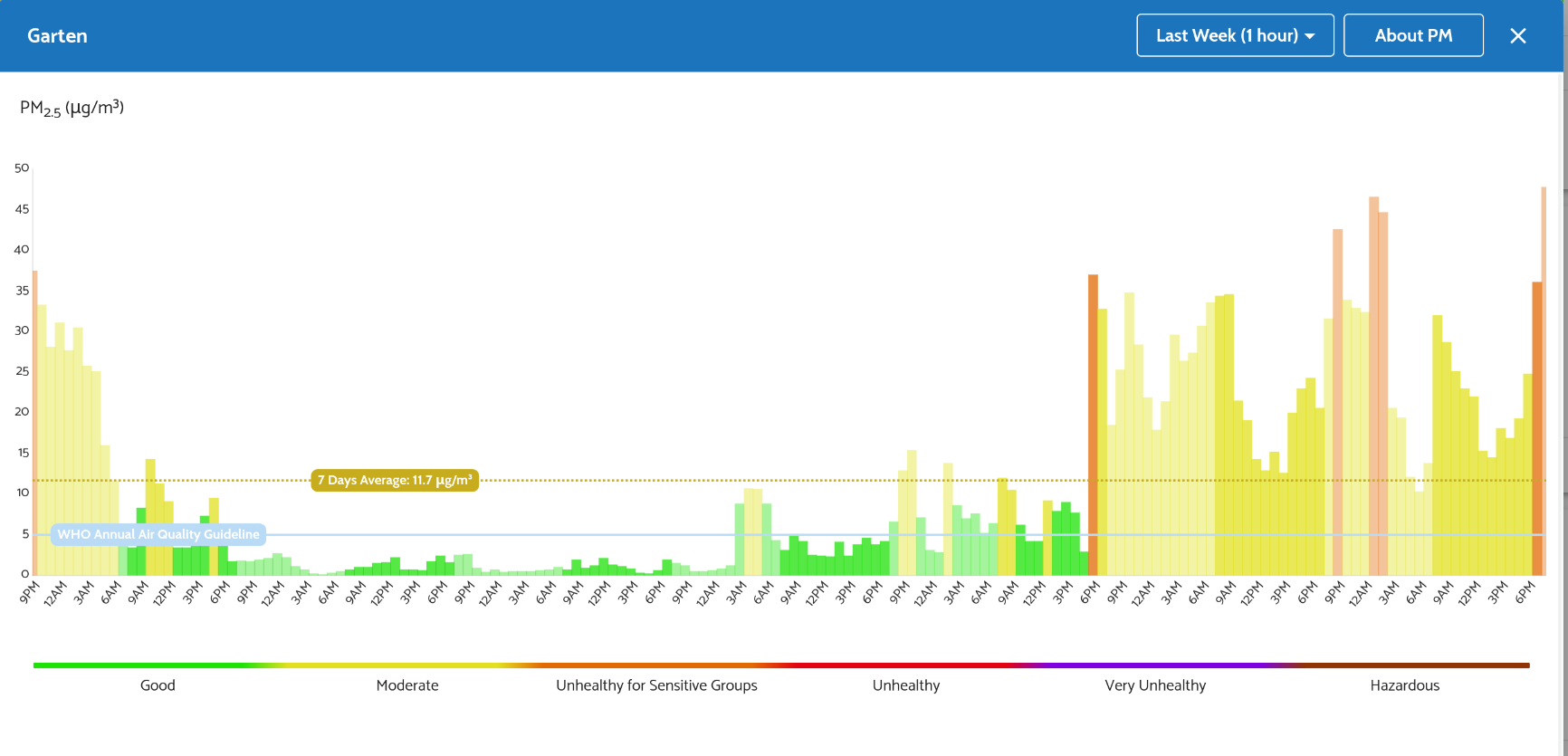 Here you can see a depiction of the fine particulates in the ambient air over the last week. It is reasonably easy to tell that in colder weather people crank up the heating more, and accordingly the outside air is more polluted. Next to the particulate graphs there are further ones for the other sensors mentioned above.
In my case it was not particularly trivial to find a suitable mounting spot for the sensor. It is powered via USB. Even though the power adapter is rated to deliver up to 2 amps at 5V, less is demanded in operation. On power draw I measured values between 1 and 2 watts, mostly somewhere around 1.5 watts. I have already floated the idea of installing an outdoor PV array with a battery. Via that I could also power devices in the yard. The cost for that ranges, depending on the model, between 150 and 300 euros, depending on how much tinkering you dare to tackle yourself. On the upside, a 4-meter-long USB-A to USB-C cable ships with the device. That should help in some situations, although presumably few people want to see cables snaking through the garden.
Airgradient One (indoor)
For clarity's sake, first a few impressions from the graphical rendering of my self-hosted Grafana.
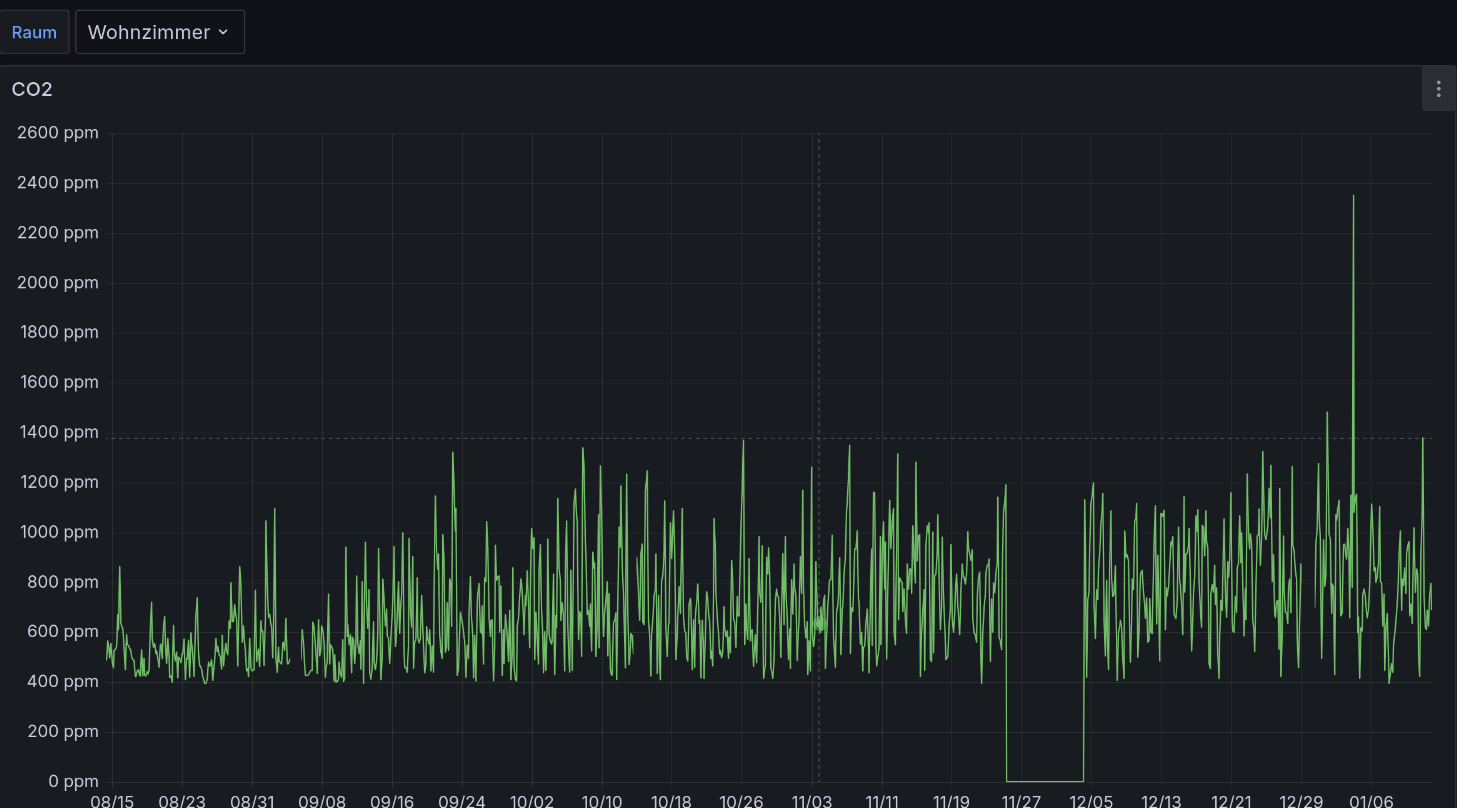 In July there was a disruption
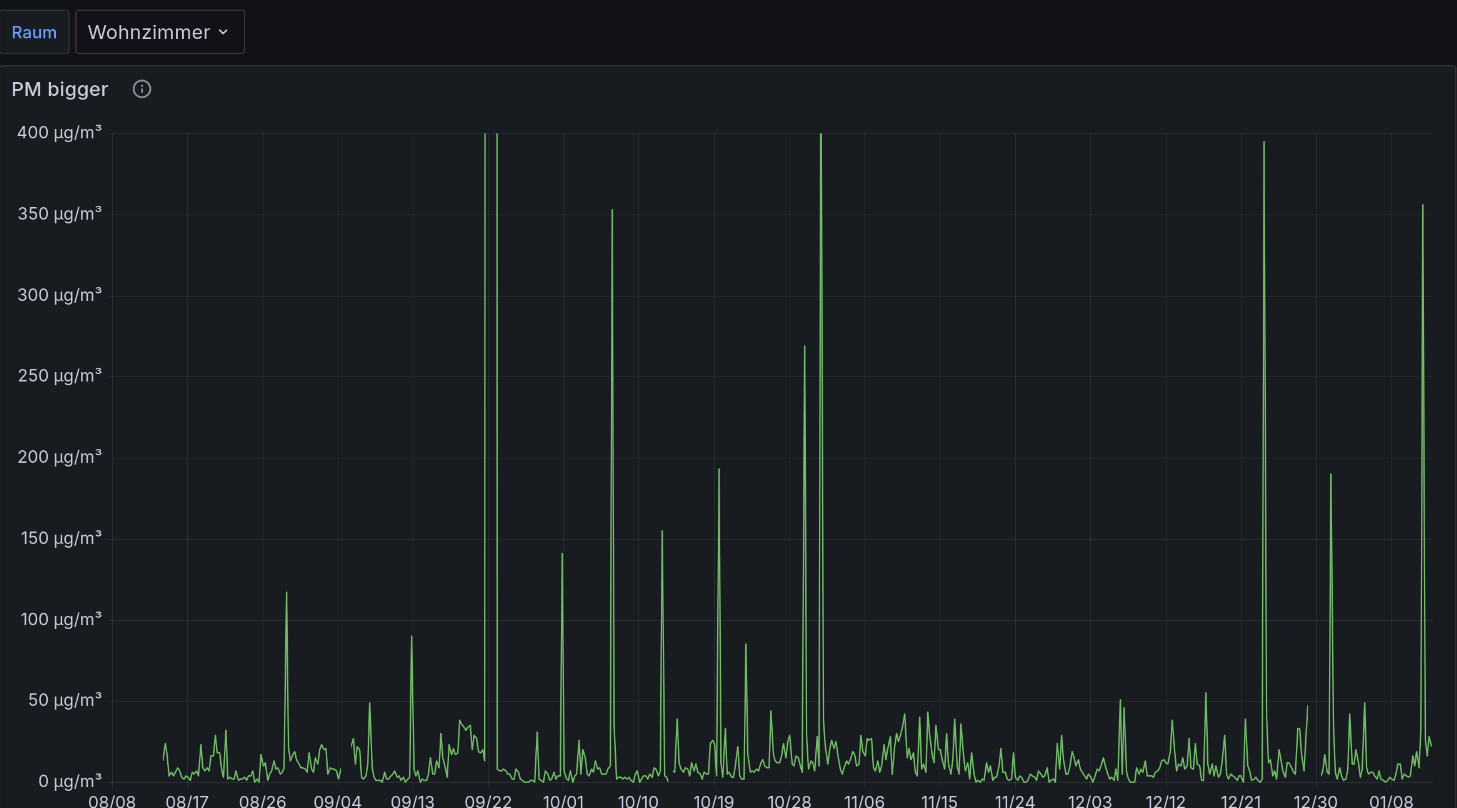
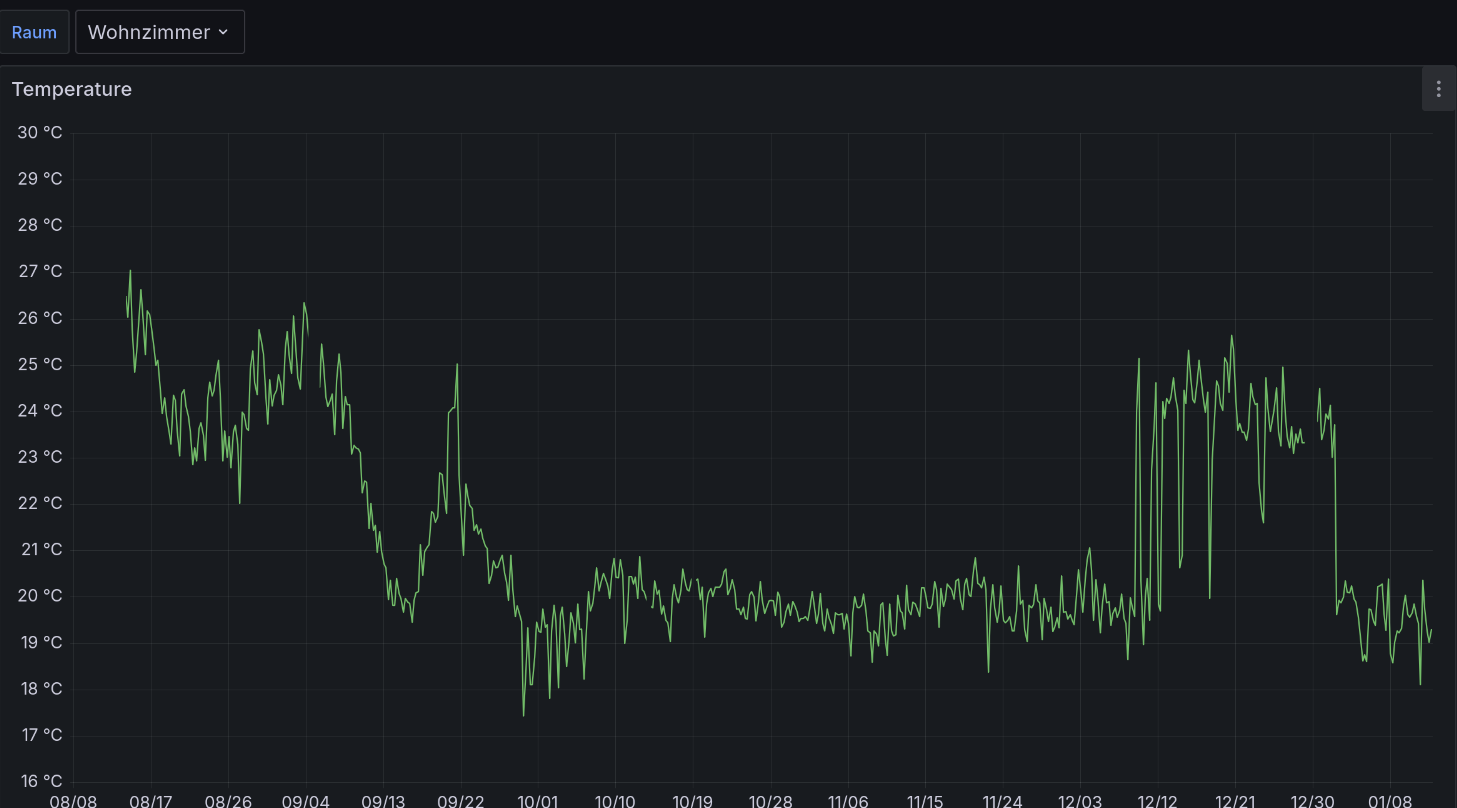
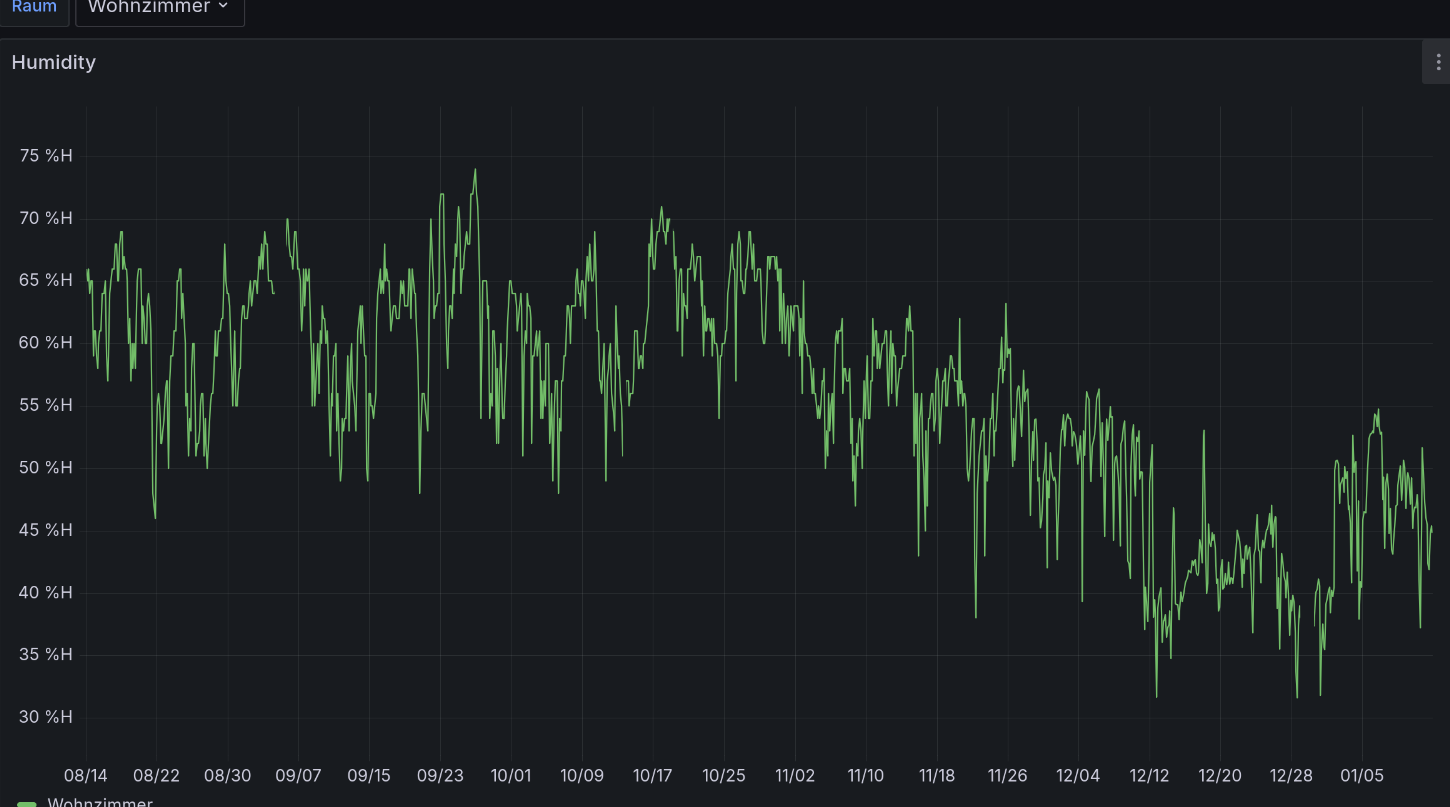
Beyond that, the sensor also apprises anyone on-site, directly via colorful LED lights on the device, of how the various measurements evolve. Plus, a small display reads out the measured values. Whereas certain events such as cooking or burning candles can indeed adversely affect the fine particulates in the air, it is the CO2 concentration that swings the most. It can impinge on wellbeing in sundry negative ways. Difficulty concentrating is only one of the well-known side effects.
All the more helpful, then, to be assisted by this — so far very dependable — sensor, for instance to ventilate more often. One thing is certain: without the sensor we vented markedly less often, especially in winter. We are very pleased with the acquisition and the outcome.